- BLOG
Best Company Search APIs for Builders in 2026
· Team at Autumn
A company search API can mean a firmographic database, a general web search category, a startup-intelligence graph, or a research agent that builds company profiles from public evidence. Those systems may all return company names, but they are optimized for different decisions.
This guide compares six options for product builders and data teams: Autumn, Exa, People Data Labs, Coresignal, Harmonic, and Crunchbase. The comparison uses public product documentation available on August 13, 2026 and avoids treating unverified coverage, accuracy, or speed claims as benchmarks.
Quick Recommendations
- Best for public-web company research with people, signals, and evidence: Autumn
- Best for company search inside a general web-retrieval stack: Exa
- Best for structured person-and-company dataset workflows: People Data Labs
- Best for configurable company-data retrieval: Coresignal
- Best for startup discovery and team intelligence: Harmonic
- Best for funding, organizations, and venture-market entities: Crunchbase
Comparison Table
| Provider | Company-search model | Best for | Distinctive strength | Important caveat |
|---|---|---|---|---|
| Autumn | Entity-centric public-web research | Emerging companies, GTM research, agents, cited profiles | Connects company facts, people, relationships, and recent signals | Deep research runs asynchronously |
| Exa | Semantic web search with a company category | Broad retrieval and custom agent pipelines | General web search and clean contents in one platform | Application may own entity joining and field validation |
| People Data Labs | Structured company dataset search | Firmographic filters and data products | SQL/Elasticsearch-style dataset access across people and companies | Best results require schema fluency |
| Coresignal | Filter and Elasticsearch search plus record collection | Data pipelines and configurable company retrieval | Multiple company datasets, preview, collect, and enrich operations | Search and full-record collection are separate |
| Harmonic | Startup-focused database, search, API, and bulk data | Startup sourcing, venture, early-company GTM | Founder, team, funding, and growth context | Specialized around startups |
| Crunchbase | Entity and collection search over venture-market data | Funding, acquisitions, investors, and organization research | Mature funding and relationship graph | Field access depends on license tier |
1. Autumn
Best for: finding and researching companies through their public signals, people, relationships, and source evidence.
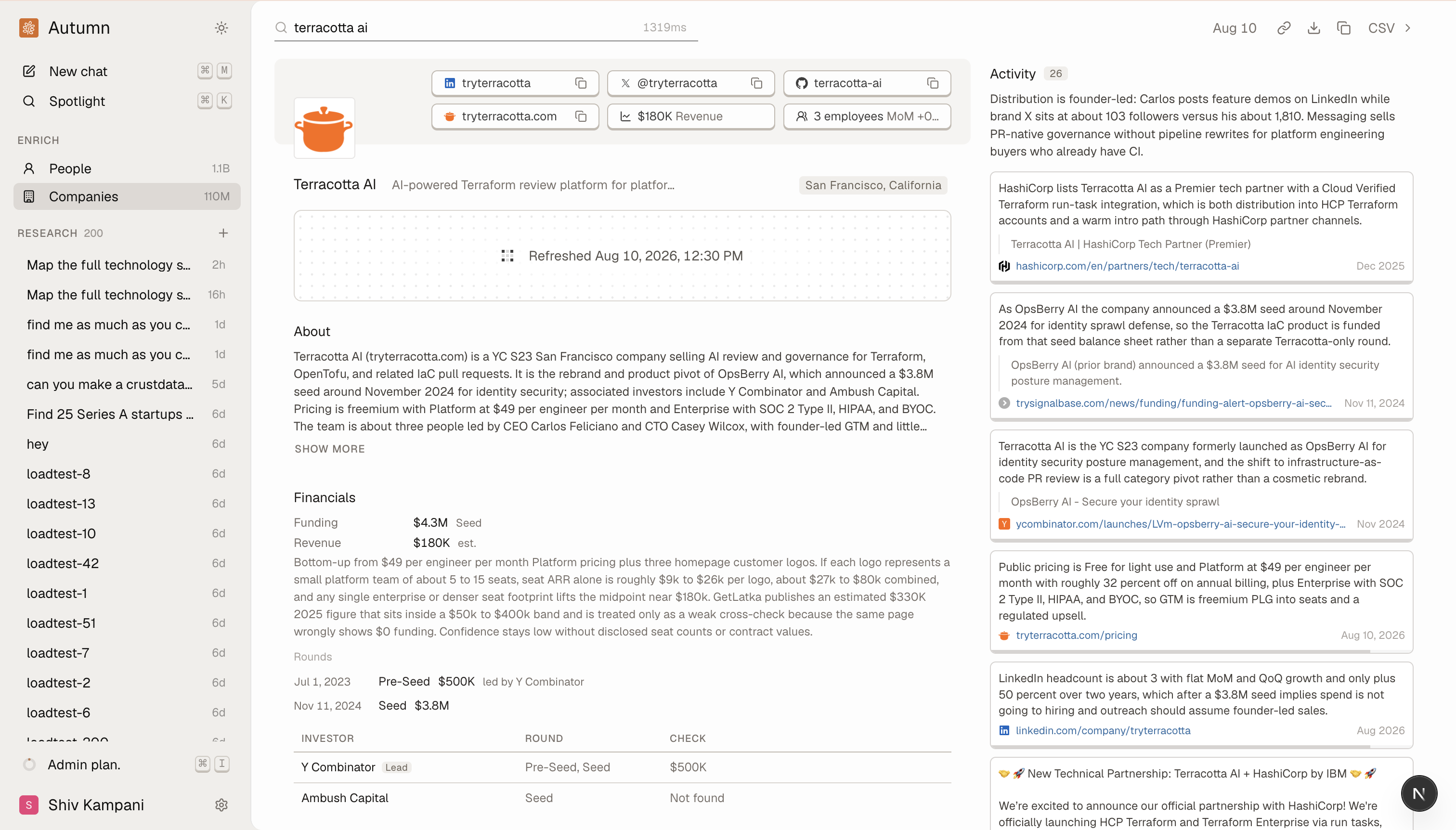
Autumn’s company model is designed for questions that cross multiple public systems. Examples include finding newly incorporated companies, resolving stealth teams, detecting new domains and hiring pages, connecting a company to founders, or building a cited profile from company sites, public filings, professional profiles, repositories, and news.
This is useful when the target company is not already a clean row in a commercial database. Autumn’s startup-data product and Brex customer story emphasize early company discovery and signals that appear near formation.
Autumn’s evidence model is also relevant for company data. A funding amount, founder identity, technology claim, and hiring signal may each come from a different page. The citation system attaches sources to the values they support rather than treating one URL as evidence for an entire record.
Autumn researches a company at request time rather than returning a stored row, so it can answer criteria a database does not hold: whether the company is SOC 2 compliant, whether it is fundraising, an estimate of revenue, whether it is hiring its first sales lead, what is in its stack, and what category of software it appears to be evaluating. Research runs asynchronously and typically takes 2 to 10 minutes depending on scope. Pricing is usage based, about 0.80 per enrichment, with batched runs cheaper per record; see the pricing page.
Strengths
- Combines companies with founders, employees, relationships, and public activity
- Handles natural-language research beyond fixed firmographic filters
- Emphasizes early and time-sensitive company signals
- Returns profiles and tables with field-level source lineage
- Supports API and agent-skill workflows
- Fast entity enrichment plus deeper asynchronous research
Limitations
- Teams needing a static warehouse-scale company dataset should compare a bulk-data provider
- Sequencing and outbound execution require a separate sales-engagement tool
- Buyers should validate specific regions, industries, and legal data rights for their use case
2. Exa
Best for: agents and products that need company search as one category inside a broader web-search system.
Exa’s Search API supports a company category alongside people, news, research papers, financial reports, and general web search. Developers can request page contents, highlights, summaries, or deeper structured output.
The general retrieval layer is the advantage. A company-research agent can find company pages, then search technical documentation, news, job posts, filings, or other domains using the same platform. The Contents API can extract clean text from known URLs and control whether to use cache or live crawling.
Strengths
- General web breadth
- Semantic and natural-language search
- Company vertical plus arbitrary domain retrieval
- Clean contents, highlights, summaries, and output schemas
- Publicly documented speed-quality modes
Limitations
- Entity resolution and company deduplication may remain application work
- A search result or extracted page is not automatically a complete company profile
- Field-level provenance across a joined company record requires additional modeling
3. People Data Labs
Best for: developers who want structured company search and enrichment alongside a person dataset.
People Data Labs exposes a Company Search API and related enrichment endpoints. Its sandbox documentation lists person and company search, company enrichment, and supporting APIs under a consistent platform.
The dataset-first model suits applications that can express the target as structured conditions and want normalized fields. It is especially useful when people and employer records must share a common data system.
Strengths
- Company and person datasets in one product family
- Structured fields and repeatable queries
- Search, enrichment, and cleaner APIs
- Pagination and predictable record schemas
- Suitable for data products and batch pipelines
Limitations
- The interface is less suited to open-ended research questions
- Developers must understand the schema and query behavior
- Current events and unsupported fields may require a separate web-research layer
4. Coresignal
Best for: data teams that need configurable company searches, preview calls, collection endpoints, and multiple levels of record cleaning.
Coresignal’s Base Company API provides filter and Elasticsearch search endpoints, preview variants, and collection by ID or profile URL. Its Clean Company API adds a cleaner dataset and an enrichment path by website.
The separation between search and collect lets teams discover IDs cheaply, inspect previews, and retrieve full records only when needed. Employee APIs can connect companies to workforce and job-history data.
Strengths
- Custom filters and Elasticsearch DSL
- Base and clean company datasets
- Preview, collect, enrich, and bulk patterns
- Documented rate limits and credit behavior
- Related employee and post datasets
Limitations
- Multi-step retrieval adds application complexity
- Natural-language research and synthesis are not the primary interface
- Evidence interpretation, entity reasoning, and business decisions stay outside the API
5. Harmonic
Best for: startup intelligence, founder research, venture sourcing, and early-company market maps.
Harmonic is purpose-built around startups and their people. Its public product describes company and person search, funding and investor data, team composition, headcount changes, growth signals, network mapping, REST and GraphQL APIs, and bulk delivery.
The API reference includes company and person enrichment. Company responses can include founders, executives, financing, team details, social metrics, and traction fields. Saved-search results support discovery workflows.
Strengths
- Deep startup and founder specialization
- Company, people, financing, team, and growth context
- REST, GraphQL, and bulk delivery
- Search and enrichment for venture and GTM workflows
- Strong fit for companies near formation and early growth
Limitations
- Less general than a broad company universe for non-startup use cases
- API access and pricing may require a sales process
- Teams should test provenance and refresh behavior for each critical field
6. Crunchbase
Best for: company, funding, acquisition, investor, and venture-market research using a mature entity graph.
Crunchbase’s Search API covers organizations, people, funding rounds, acquisitions, and other collections. Organization search accepts field selections and structured predicates; filters are combined with AND, and multiple calls are required for some OR behavior.
The Entity Lookup API can retrieve organization fields and relationship cards such as founders and funding rounds. This makes Crunchbase a natural choice when financing and venture relationships are central.
Strengths
- Organization and venture-market entity graph
- Funding rounds, investors, acquisitions, founders, and categories
- Structured search and entity lookup
- Mature identifiers and relationship collections
- Clear collection-oriented API model
Limitations
- Available fields and endpoints depend on the license tier
- Search predicates have operator constraints
- Very early or unconventional public-web signals may require another source
How the Architectures Differ
Dataset APIs
People Data Labs, Coresignal, Harmonic, and Crunchbase primarily expose normalized records and structured relationships. They are strongest when the required fact exists in the provider’s schema and index.
Web Search APIs
Exa starts from retrieval. It is strongest when a developer wants broad control over finding pages, extracting content, and defining a custom reasoning pipeline.
Entity-Centric Research APIs
Autumn starts from the company or person and assembles a result across sources. It is strongest when the output must combine identities, relationships, live signals, and evidence.
Many systems use more than one architecture. A dataset can seed the candidate universe, public-web research can update or validate it, and the application can preserve one canonical entity record.
Evaluation Checklist
Test company search with cases that reflect the real product:
- A well-known company with clean identifiers
- Two companies with the same or similar name
- A newly formed or stealth company
- A company that recently changed its name or domain
- A subsidiary and its parent
- A closed company with stale pages
- A market cohort defined by firmographics
- A cohort defined by live public signals
- A query requiring founders or leadership
- A query where no valid company should be returned
Measure:
- Entity precision and duplicate rate
- Recall for the target market
- Freshness by field
- Founder and employee linkage accuracy
- Source coverage
- Structured-field completion
- Cost and latency per accepted company
- Pagination and rate-limit behavior
- Rights, suppression, and audit support
Bottom Line
Autumn is a strong fit when company search is inseparable from people, relationships, current public signals, and evidence. Exa fits products that want company-category search within a broad web retrieval platform. People Data Labs and Coresignal fit structured data systems. Harmonic fits startup intelligence. Crunchbase fits funding and venture-market research.
For the people side of the market, see Best People Search APIs for Builders in 2026. For a deeper view of entity-centric versus general retrieval architectures, see Autumn vs. Exa for People and Company Search.
Developers can inspect the current interface in the Autumn API documentation.